 STUUBZZZ
MiniMax H3 long videos in ComfyUI: retake one chunk, keep the rest (Ultimate H3 0.13)
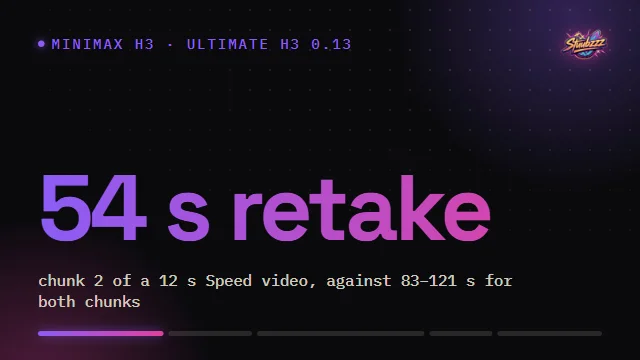
Ultimate H3 0.13 renders long MiniMax H3 videos in ComfyUI in chunks. On an RTX 5090, retaking chunk 2 of a 12 s Speed video took 54 s, both chunks 83 to 121 s.
Custom AI image and video pipelines that lock a character, product or style, then reproduce it at production scale. Built on your infrastructure. Owned by you, not rented from a SaaS.
The same pipelines, explained from the first node. Start free and go as deep as you like.
A character, product or style locked into a pipeline your team runs without me.
A three-part course that explains the machine instead of handing you another workflow to copy. Part 1 is the whole beginner course and it is free.
Install ComfyUI, build the seven-node text-to-image workflow from an empty canvas, and fix the eight errors beginners actually hit.
Change a downloaded workflow and know what will happen before you press Run.
Train your own LoRA, merge models, write a custom node and run your workflow from a script.
Generic tools hand you a new character, product or style each time you press generate. Campaigns need the same one, across a hundred stills and every second of video.
The fixA trained consistency LoRA and reference system that locks your subject, so it stays itself from front, side and in motion.
Midjourney, Runway, Sora: per-seat fees forever, output caps, and your prompts, references and IP leaving your walls on someone else's servers.
The fixThe whole engine deployed on your hardware or private cloud. You run it, you own it, and the marginal cost of the next asset is near zero.
The fastest route to a repeatable visual identity your team can run without me.
Outcome: unlimited on-brand stills and video, in-house, at near-zero marginal cost.

Same identity in every frame. How the dataset is built
Patrons get them first, then they go public on GitHub with a walkthrough video. Everything in the reel above was rendered with these two workflows.
 MiniMax H3
One MiniMax H3 workflow for ComfyUI. Speed, Hybrid and Quality modes, seed hunting with full videos and sound, LoRAs per chunk, 24 to 120 fps, and RTX VSR or DLSS 5 up to 4K.
Get it on GitHub LTX 2.5
The same idea for LTX 2.5: seed hunting with full videos, a full-size first pass, Licon MSR reference images in both passes, audio lock on the refine, and output up to 4K.
Get it on GitHub LoRA · write-up
A style LoRA that holds the 2.5D look MiniMax H3 tends to skip. The post covers how it was trained and which strength to use, and the newest version's training run is on screen in Part 3 of the course.
Read how it was made


Frames from the two workflows' release videos. Every one was rendered locally. Setup guides: Stubelius Ultimate H3 · Stubelius Ultimate LTX 2.5.
Character sheets, turnarounds and real-time talking avatars, locked to your canon.
Endless on-brand product, lifestyle and ad creative without a photoshoot per campaign.
Ad variations at scale across clients. White-label the whole pipeline behind your name.
The full character lifecycle, from bible and LoRA to launch and monetization.
Multilingual avatar video and localized course content, produced at volume.
Swap characters into reference footage with matched audio, across languages.
Start small and self-serve, commission a fixed-scope build, or bring me in ongoing.
For creators and in-house teams getting unblocked fast.
Fixed scope, fixed price, yours to keep and run.
For volume, or when you'd rather it just run.
Custom ComfyUI nodes, LoRA training and diff-LoRA merges, and self-hosted video generation on the current open-source frontier: LTX 2.5 and MiniMax H3. I've taken two AI characters from bible to launch, and I run a paying community of builders on the same tools I'd hand your team.
And after twelve years in business development, I care whether the pipeline actually ships and pays back, not just whether the demo looks clever.
A build runs in four steps: a scope call, the build itself, a handover that trains your team to run the engine, and scaling up when you want more volume.
We define the subject to lock, the output you need, and where it runs.
Character design, LoRA training, and the workflow and prompt-assistant around it.
Your team is trained to run and extend the engine on its own.
Move to a retainer or white-label when you want more volume.
Settings, benchmarks and teardowns from the same LTX 2.5 and MiniMax H3 builds that go into client work.
Ultimate H3 0.13 renders long MiniMax H3 videos in ComfyUI in chunks. On an RTX 5090, retaking chunk 2 of a 12 s Speed video took 54 s, both chunks 83 to 121 s.
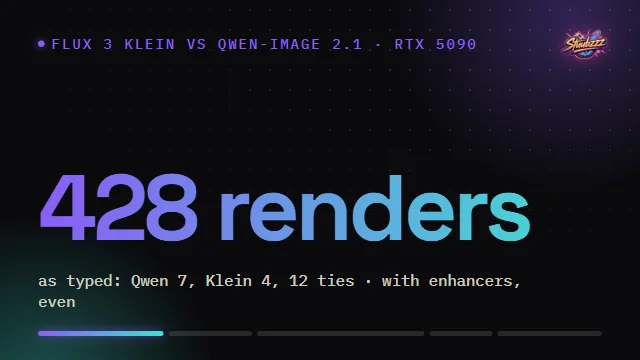
In 428 renders on an RTX 5090, prompts as typed, Qwen-Image 2.1 won 7 of 23 image types to FLUX 3 Klein's 4 (12 ties). Klein won short text, Qwen editing.
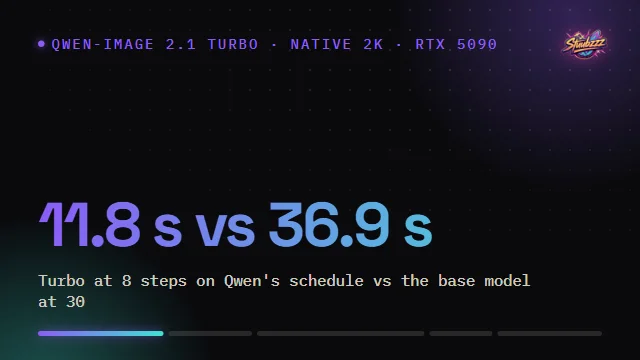
Qwen-Image 2.1 Turbo made a native 2K image in 11.8 s vs 36.9 s for the 30-step base model on an RTX 5090, and needs Qwen's 8-step sigma schedule in ComfyUI.
Tell me the subject you need to reproduce and where it should run. I'll come back with scope and a fixed price.